home about map history images contact sponsors

ABOUT: PROJECT HISTORY

In the summer of 2006 I received a residency grant from the Berwick Research Institute (located in Dudley Square) to develop this project. There I received invaluable feedback and support from Susan Sakash and Andi Sutton. I also did a trial at the CAVS (Center for Advanced Visual Studies) at MIT.

Virtual Corners is closely related to a project that I created called Symphony of a City which premiered in Boston Cyberarts Festival 2001. Symphony of a City used headcams, projections and streaming video to paint a portrait of Boston through the eyes of eight different residents.

Both pieces evolve out of earlier work creating participatory community public art projects across Boston. In doing those projects I was struck by the diversity of culture as well as the segregation that still permeates this city. Residents of Boston appear to treat the situation as normal and little dialogue appears to take place around the issue. This work invites people to confront this reality and gives them an opportunity to reflect on it and dialogue about it. It also allows them to experience the city in a new way outside their daily routines.

In recent research, I ran across a quote from Henri LeFebvre, who was associated with the Situationists. He described one of their earlier concepts - "their idea was that in the city, one could create new situations by, for example, linking up parts of the city, neighborhoods that were separated spatially. And that was the first meaning of the word derive. It was done first in Amsterdaam, using walkie talkies." The Derive and Psychogeography have become somewhat of a buzz-word these days,but I thought it was interesting that they were experimenting with this same concept.

Challenges and Possible Solutions
The primary challenge of any participatory art project is in how one engages the audience. If no one is lured to participate, the dynamism of the project can be lost.

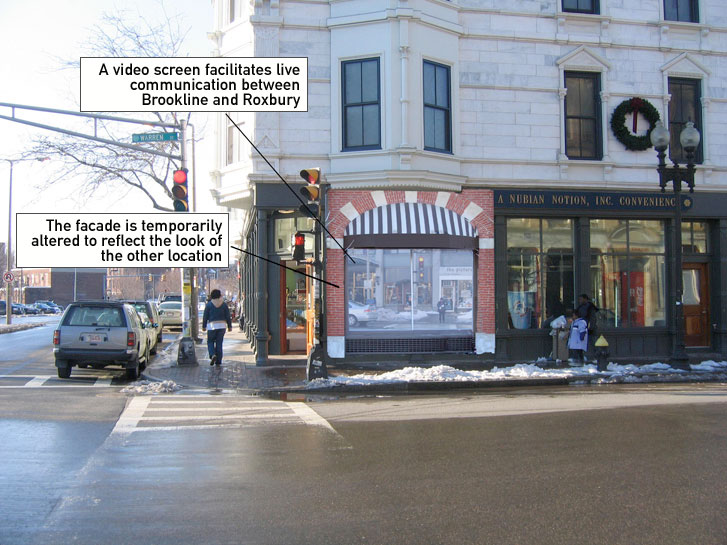
In this particular piece –because of the placement of the sites and transmission of life size figures from one location to the other — I believe it will be interesting even if nobody stops to converse with each other. Because this is a kind of social experiment it will be interesting just to see how people react.

However I believe it will be much more interesting if people actually have conversations between neighborhoods and end up traveling from one location to the other. My inclination is to not interfere too much in order to achieve this objective. Possible ideas to play with include presenting provocative topics/questions or interesting facts, asking individuals to give a daily report or journal about what is happening in their neighborhood or replaying highlights of previous conversations so people could build on them. A more active approach would be to arrange dialogues and performances that would occur at particular times.

For more information or to schedule an interview, contact John Ewing 857-719-4877, www.virtualcorners.net or www.johnewing.org


For more information or to schedule an interview, contact John Ewing 857-719-4877, www.virtualcorners.net or www.johnewing.org